Outsourced payroll can work extremely well, but only when the payment process is managed with discipline. Payroll is not simply about calculating wages. It is also about making sure the right funds, approvals, payroll data and payment instructions are in place at the right time.
When payment coordination is weak, problems appear quickly. Workers may be paid late. HMRC submissions may need correction. Payslips may be delayed. Client finance teams may be asked for urgent approvals at the last minute. Payroll teams may be forced to process under pressure, increasing the risk of mistakes.
In sectors that rely on weekly or high-volume payroll, these risks are even sharper. Recruitment agencies, labour providers, umbrella companies and contractor-heavy businesses often operate on tight payroll cycles. A delay of a few hours can affect hundreds of workers, especially where payroll is linked to assignment data, approved timesheets and cleared client funds.
A controlled payment process should start before the pay run. The provider needs to know who is being paid, what period is being processed, what hours or units have been approved, what deductions apply, what bank details are valid and whether the required funds are available.
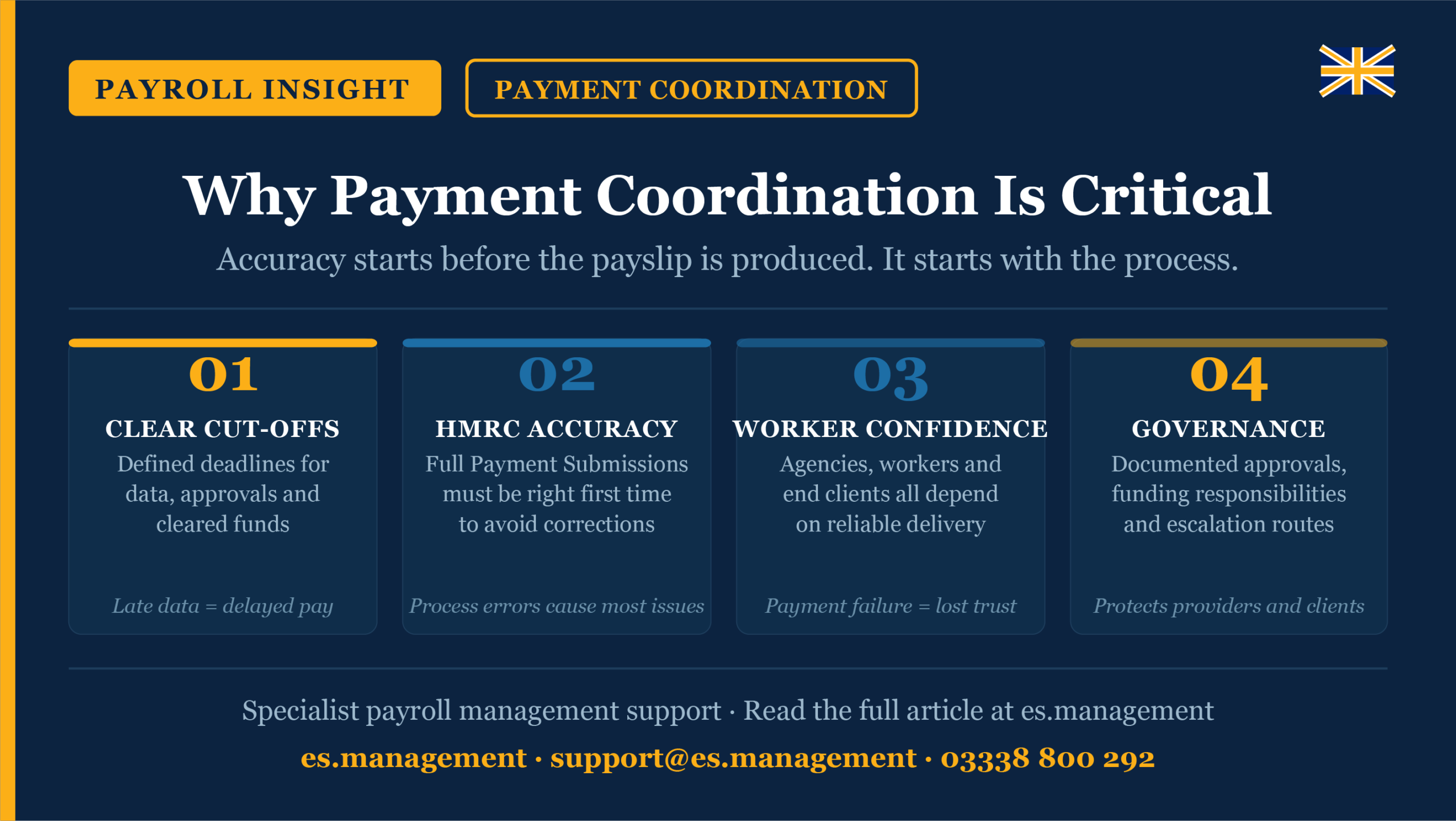
This is where clear cut-offs matter. If payroll data and cleared funds arrive late, the provider is placed in a difficult position. Either the pay run is delayed, or the team rushes the process and increases the chance of error. Neither outcome is good for the client, the provider or the worker.
Payment coordination is also linked to HMRC reporting. PAYE payroll requires accurate reporting to HMRC, and the Full Payment Submission tells HMRC about employee payments and deductions. If payroll data changes after submission, correction work may be required. GOV.UK provides separate guidance for correcting mistakes in Full Payment Submissions or Employer Payment Summaries.
That correction work is avoidable in many cases. Most issues come from poor process rather than complex law: late timesheets, unclear approvals, missing worker information, incorrect rates, changed bank details, disputed hours or assumptions about who is responsible for funding the payroll.
A strong outsourced payroll model should therefore include:
- clear payroll calendars;
- defined submission deadlines;
- named client contacts;
- evidence of approval;
- documented funding responsibilities;
- checks on worker and bank details;
- escalation routes for missing information;
- records of any changes made after approval.
This is not just internal housekeeping. It is part of good governance. Businesses using outsourced payroll need to show that they have proper control over worker payments and payroll instructions. Providers also need to protect themselves by ensuring they are not expected to process incomplete or unsupported information.
For agencies and contractor-led businesses, payment coordination also protects commercial relationships. Workers expect to be paid correctly and on time. End clients expect smooth delivery. Agencies expect the payroll provider to operate reliably. When payments fail, confidence drops quickly.
The best payroll support therefore combines technical payroll knowledge with practical management. It is not enough to know how to calculate PAYE, holiday pay, deductions or pension contributions. The provider also needs to manage timing, communication, approvals and funding.
That is where specialist payroll management support adds value. It helps create a structured operating process between the client, payroll provider and other parties involved. It reduces confusion, improves accountability and gives the payroll team a cleaner set of instructions to work from.
Payment coordination is not the most glamorous part of payroll, but it is one of the most important. If the money, data and approvals are not controlled, the whole payroll process becomes fragile.
In outsourced payroll, accuracy starts before the payslip is produced. It starts with the process.