This is particularly important where payroll involves temporary labour, agency workers, umbrella arrangements, CIS subcontractors or multi-site workforces. These models often involve several parties: the end client, agency, payroll provider, umbrella company, contractor, worker and sometimes a separate compliance or onboarding team. Without clear management, responsibility can become blurred.
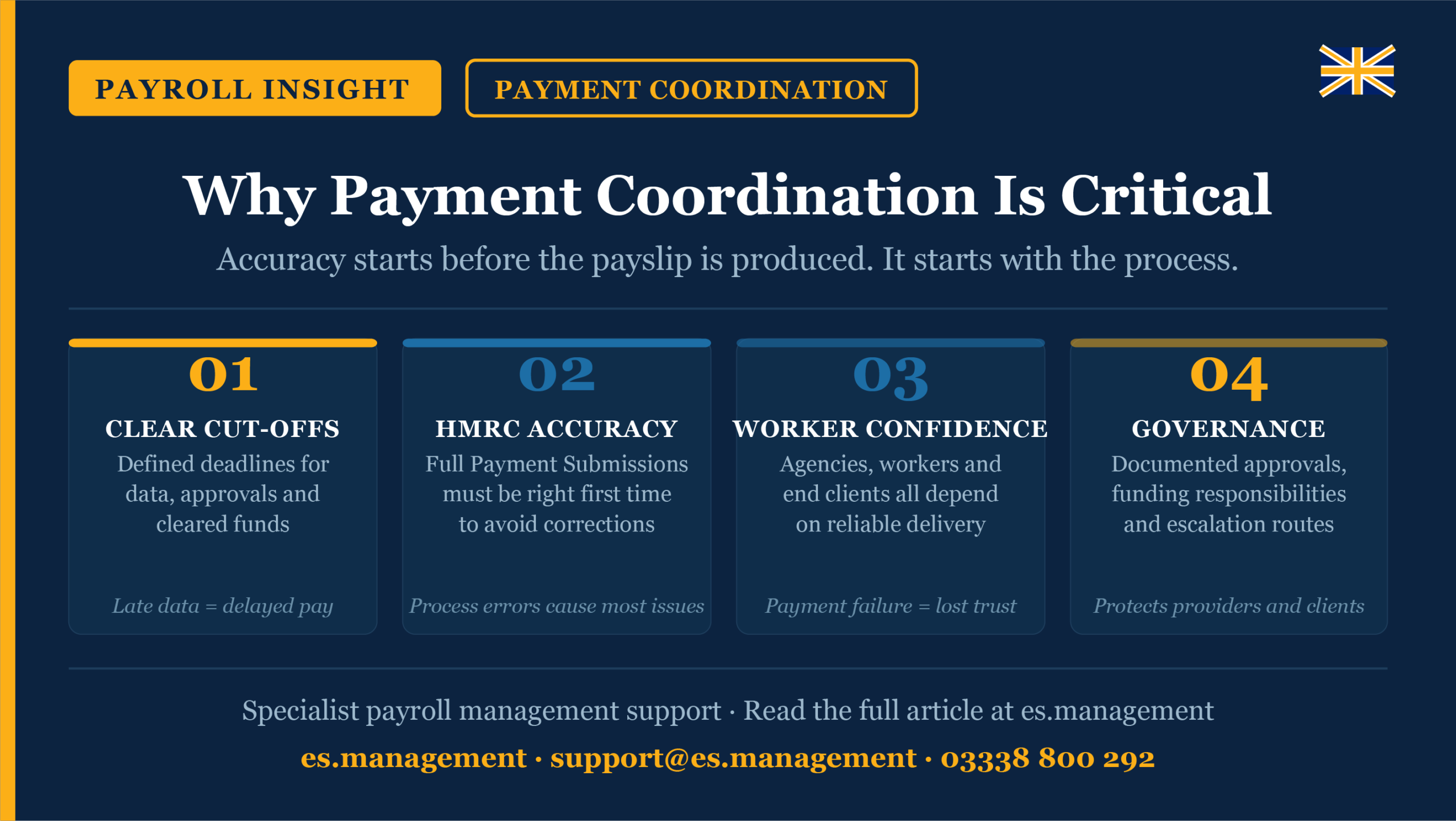
One of the key compliance pressure points is Real Time Information reporting. Employers must use payroll software to send a Full Payment Submission to HMRC showing payments to employees and deductions made from their pay. HMRC guidance states that a Full Payment Submission is used to tell HMRC about payments made to employees and the deductions taken from pay.
That means poor payroll data is not just an internal inconvenience. It can create incorrect tax reporting, incorrect PAYE liabilities and avoidable correction work.
Client management also matters because payroll is time-sensitive. A missed cut-off can create immediate consequences: late wages, delayed payslips, rushed approvals, incomplete checks and pressure on finance teams. When payroll is managed casually, the provider often ends up firefighting instead of operating a controlled process.
A better model is to treat client management as a formal operating function. This means having clear onboarding requirements, documented responsibilities, agreed cut-off times, evidence of instructions, issue logs, escalation routes and a proper record of what was received, when it was received and who approved it.
For agencies and businesses, this provides reassurance. They know what information they need to provide and when. For payroll providers, it protects the processing team from avoidable errors. For workers, it helps ensure they are paid accurately and on time.
The regulatory environment also makes strong client management more important. Companies House identity verification requirements became a legal requirement from 18 November 2025, with a 12-month transition period for directors and people with significant control. This is part of a wider movement towards stronger business transparency, better due diligence and more accountable company administration.
Payroll providers should not see this as separate from their own work. The same principle applies: know who you are dealing with, document the relationship clearly and make sure the operating process is controlled from the outset.
Strong client management is not bureaucracy for the sake of it. It is what prevents misunderstandings, disputes, delayed payments and compliance failures. In a sector where accuracy, timing and trust are everything, the best payroll providers are not just processing payslips. They are managing relationships, information, risk and accountability.